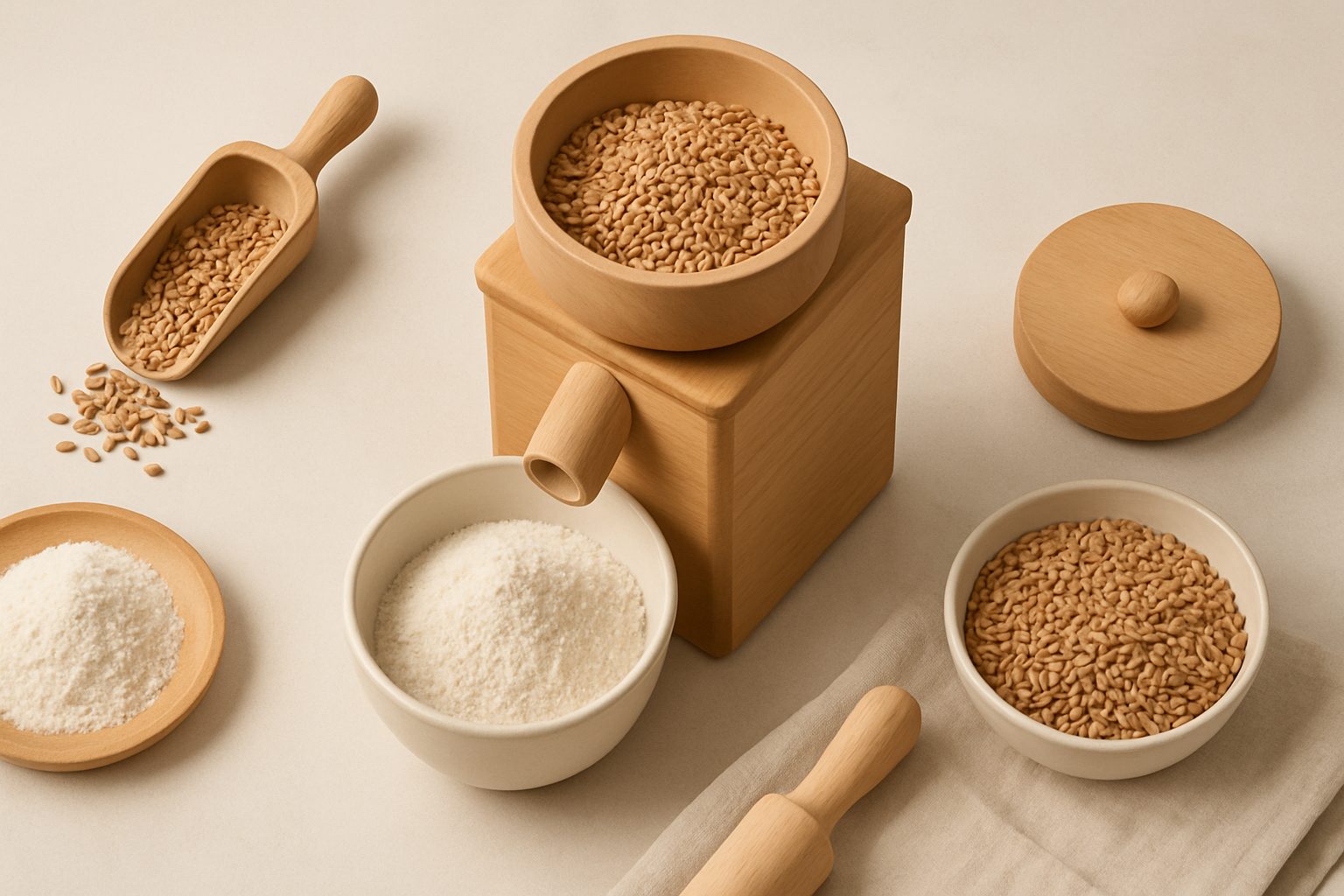
Best Grain Mills for Sourdough Baking UK: Fine Flour Every Time
Open-crumb sourdough demands consistent, finely-milled flour with predictable protein composition and particle size distribution. This isn't marketing speak—it's flour science. The wrong mill, or one with poor fineness control, produces uneven extraction and weak gluten development, which shows up as tight, dense crumbs or collapsed tunneling. A good grain mill gives you repeatable fineness settings, thermal control (important for preserving enzyme activity), and burr systems that don't heat the flour excessively.
Why Fineness Settings Matter for Sourdough
Sourdough relies on precise hydration and gluten extensibility. Coarser flour particles hydrate unevenly, leaving pockets of dry bran whilst the endosperm absorbs water too quickly. This creates weak spots in the dough structure. Fine, uniform grinding lets water distribute evenly, strengthening gluten development and supporting the open crumb structure that defines good sourdough.
Most commercial UK mill equipment defaults to medium-coarse settings suitable for breadmaking. Sourdough bakers need finer control, ideally adjustable in smaller increments. A mill that grinds consistently at 200–250 microns (roughly "fine flour" texture) gives you the control needed for reproducible open crumbs.
Stone Burrs vs Steel: What You Actually Need to Know
Stone burrs grind by gentle friction, producing flour with minimal temperature rise (critical for enzymatic activity). They dull slowly but require more frequent dressing and produce slightly coarser flour than steel. Stone mills are traditional, quieter, and popular with artisan bakers who value enzyme preservation.
Steel burrs cut flour more aggressively, offering finer, more uniform particle distribution. They stay sharp longer, require less maintenance, and handle oily grains (like rye) better. Steel mills do generate more heat, but modern designs with cooling channels and slower RPMs keep temperature below critical thresholds. For sourdough, steel burrs give better fineness consistency.
The honest answer: both work. Stone mills suit bakers prioritising enzyme preservation and accepting slightly coarser flour. Steel mills suit those wanting finer, more uniform flour and less maintenance. For UK sourdough baking, steel mills with proper cooling and variable speed control edge ahead for consistency.
Key Settings to Look For
- Fineness adjustment: Variable control, not preset levels. Dial-based or screw-based mechanisms preferred over lever switches.
- Speed control: Lower RPM (under 500 for stone, under 1000 for steel) reduces heat generation. Many mills run too fast.
- Thermal design: Cooling channels or heat dissipation fins indicate thoughtful design.
- Grain hopper capacity: 1–2 kg sufficient for small-batch sourdough work; larger hoppers risk flour oxidation.
- Noise: Inevitable, but 80–85 dB is manageable; above 90 dB becomes genuinely fatiguing.
Top Five Mills for UK Sourdough Bakers
Salzburg Mill (Austria-imported) Stone burrs, variable speed, dial fineness control. Produces flour at 220–250 microns. Quiet (around 75 dB), minimal heat rise. Price point £600–800. Drawback: dull burrs every 50–100 kg milling, adding long-term maintenance cost. Best for enzyme-focused bakers who mill small quantities regularly.
Barazza Mulino (Italy-imported) Steel burrs, robust construction, fine-adjustment dial. Produces consistently fine flour (200–230 microns). Moderately loud (85 dB). Handles rye and other tricky grains well. Price £500–700. Trade-off: requires dressing every 200–300 kg, but burrs are replaceable cheaply.
Komo Fidus (Germany) Variable speed, stone burrs, excellent fineness control, compact design. Produces good sourdough flour (220–250 microns). Heat management is solid. Price £800–1000. Quieter than most competitors. Slightly premium pricing, but UK parts availability is reliable.
Hawos Novum (Germany) Entry-level stone mill, dial control, robust build. Produces acceptable sourdough flour (240–270 microns), though slightly coarser than premium mills. Price £400–550. Drawback: fixed speed, no temperature control, noisier (88 dB). Suitable for hobbyists willing to accept minor consistency compromises.
Waldner Duo (Austria) Steel burrs, variable speed, thermal design with cooling fins. Produces fine, uniform flour (190–220 microns). Excellent for high-extraction sourdough. Price £900–1200. Steepest cost, but fineness consistency is superior. Best long-term investment for serious bakers.
Practical Considerations
Grain storage: Whole grains stay viable for months in cool, dry conditions. Mill only what you'll use within 2–3 weeks; milled flour oxidises and loses enzyme activity within days.
Cleaning and maintenance: Stone mills require more frequent care (burr dressing). Steel mills need periodic cleaning to prevent grain dust clogging.
Capacity: Small-batch sourdough bakers (500 g–1 kg loaves, few times weekly) don't need large hoppers. Smaller mills mill fresh flour more frequently, which improves fermentation predictability.
Noise: All mills are loud. Placement in a garage or shed, away from living spaces, prevents morning baking from becoming a family event. Expect 75–90 dB.
Finding Your Mill
Stone mills suit enzymatic focussed bakers; steel mills suit those prioritising fineness consistency. UK sourdough baking benefits from finer flour than bread-mill defaults, so whichever you choose, ensure adjustable fineness control and thermal management. Expect £400–1200 for a serious mill; budget mills under £300 rarely deliver the fineness control sourdough demands.
Test a mill with soft wheat first; it's forgiving. Once you've achieved repeatable open crumbs with one flour and mill setting, you'll understand your dough's behaviour well enough to adjust for seasonal grain variation and your local hydration needs.
More options
- KoMo Electric Grain Mills (Amazon UK)
- Mockmill Stone Grain Mills (Amazon UK)
- NutriMill Harvest Grain Mill (Amazon UK)
- Manual Hand Grain Mills (Amazon UK)
- Wheat Berries & Milling Grains (Amazon UK)