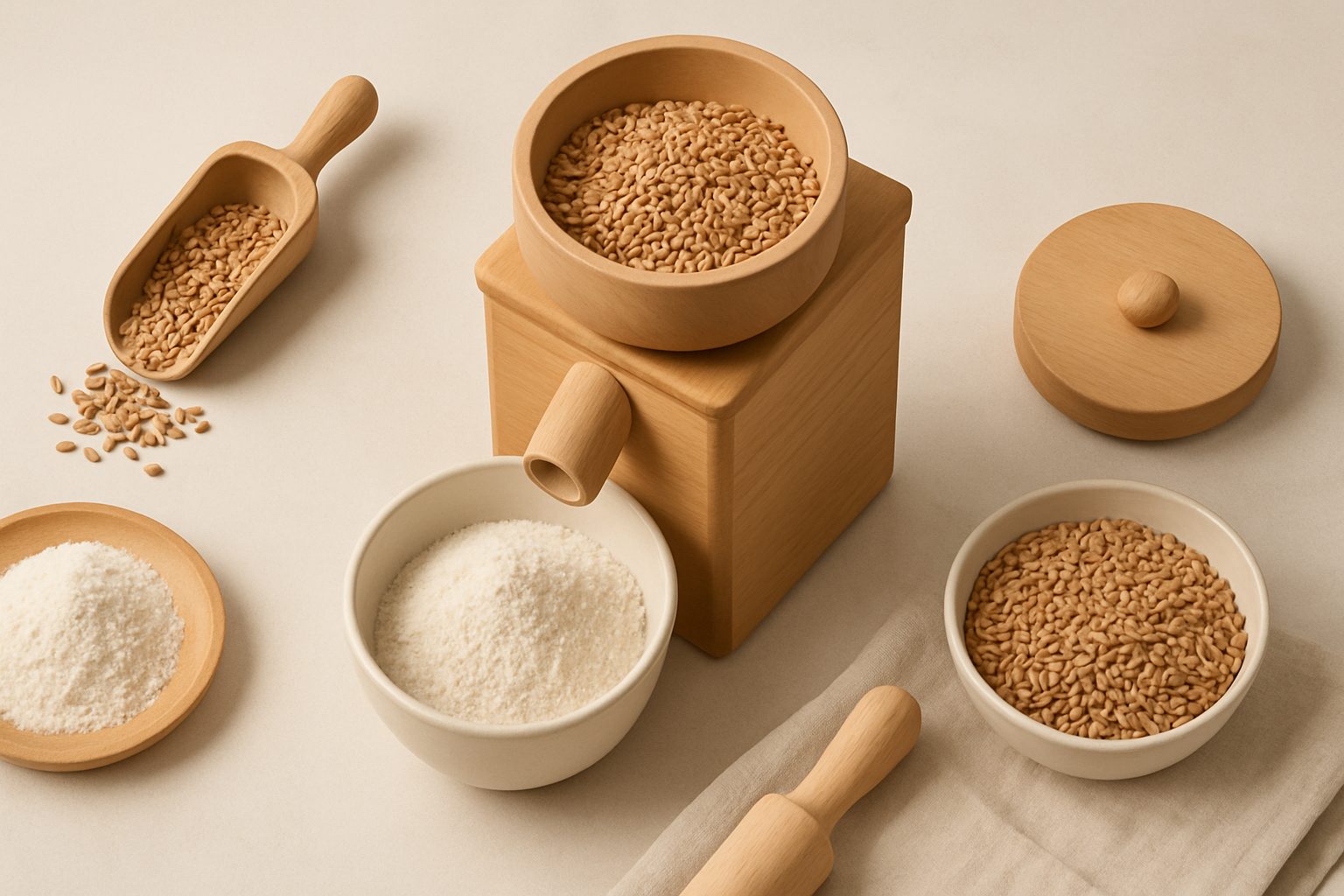
What to Look for When Buying a Home Grain Mill UK: 7 Key Factors
Buying a home grain mill is a significant investment if you're serious about freshly milled flour, animal feed, or specialty grains. Unlike commercial mills, home models must balance grinding performance with space, noise, and budget constraints. Getting the right one depends on understanding what actually matters for your needs.
Burr Type: Steel vs Stone
The grinding mechanism is your mill's heart. Electric home mills use either steel burrs or stone burrs—each with real trade-offs.
Steel burrs (usually conical or flat) are the standard in most affordable UK mills. They're durable, heat less during grinding, and produce consistent particle sizes. They work well for wheat, spelt, and tougher grains. The downside: they can wear over years (typically 5-10 years of moderate use before replacement), and some people find the grind slightly less "traditional" in texture.
Stone burrs (usually ceramic or natural stone) grind slower and gentler, preserving more nutrients if that matters to you. They're quieter. The catch: they chip more easily, generate more heat, and are less forgiving with oily seeds or damp grains. They're generally found on higher-end or speciality mills.
For most UK home millers starting out, steel burrs make practical sense. If you're planning to mill several times a week and want longevity without replacement costs looming, steel is the better bet.
Motor Wattage and Grinding Power
Don't assume higher wattage always means better milling. A 500W motor properly engineered beats a poorly designed 1000W motor.
That said, wattage does matter for what you can actually grind. Most home mills sit between 400–2000W. If you're only doing fine wheat flour occasionally, 400–600W is adequate. For regular milling, softer grains, or anything tougher (like oats or corn), aim for at least 800W. Mills under 500W can struggle or stall with denser grains—frustrating and potentially damaging to the motor.
Check whether the motor has thermal overload protection. Cheaper mills sometimes lack this, meaning you risk burning out the motor if it stalls. It's a small feature that separates good value from false economy.
Hopper Size and Capacity
Hopper size determines how often you need to refill. Typical home mills have hoppers from 0.5 kg to 5 kg.
If you're milling occasionally—say, a couple of times a month for household use—a 1–2 kg hopper is fine. If you're doing this weekly or supplying neighbours, go larger. A 3–5 kg hopper saves time and is less fiddly, but occupies more counter or shelf space.
Also check the mill's output capacity per hour. A hopper might hold 3 kg, but the mill might only grind 0.5 kg per hour—meaning it's a slow process. Real-world milling speeds for home mills are typically 0.3–2 kg/hour depending on grain type and fineness setting. Coarse grinds are faster; fine flour takes longer. Factor that into your decision if you're processing significant amounts.
Noise Level
Home mills are loud. There's no getting away from it. But some are much worse than others.
Expect 80–95 decibels depending on the model and grain type. That's roughly the volume of a food blender or lawnmower. Some mills push 100dB, which is genuinely disruptive in a quiet home or flat.
If noise is a real concern, stone burr mills tend to be quieter, as do mills with better vibration dampening. Mounting the mill on a rubber mat or in a dedicated cupboard helps absorb sound. But be honest with yourself: if you live in a flat or mill regularly, a loud mill will grate on you (and your neighbours).
Warranty, Build Quality and Support
A good warranty reflects the manufacturer's confidence—and protects you. Most decent UK mills come with 1–3 year warranties. Cheap mills often have 6-month or no coverage.
Beyond warranty length, check what's actually covered. Some exclude wear parts (burrs, gaskets). Others have decent after-sales support in the UK, with replacement parts readily available and not eye-wateringly expensive.
Look at online reviews but take them with perspective. A single bad experience doesn't tell you about reliability across hundreds of units. What matters more: can you actually get customer support, or spares, if something fails? Mills from established European manufacturers (even if sold under UK brands) usually have this. No-name imports sometimes don't.
Consistency of Grind and Fineness Control
You need to be able to dial in the fineness you want. Most home mills have an adjustment screw or lever that lets you go from coarse (cracked grain) to fine (flour). The best ones adjust smoothly without jamming or requiring tools.
Some mills grind inconsistently—mixing fine and coarse particles in the same batch. That's usually a sign of burrs wearing or a poor design. Good mills produce relatively uniform particle size across the grind.
If you're grinding for baking, fineness control is essential. If you're just cracking grains for animal feed, it matters less.
Price and Value
Home mills in the UK typically range from £200 to £1500+. Budget mills (£200–400) often have smaller motors, plastic hoppers, and thinner warranties. Mid-range (£400–800) is where most reliable, capable home mills sit. Premium (£800+) brings quieter operation, better build quality, and sometimes stone burrs.
Don't assume expensive means better for your needs. A £500 mill from a reputable maker often outperforms a £1200 boutique model if the boutique model was designed for aesthetics rather than function.
Final Thought
The best home grain mill for you depends on what you're actually grinding, how often, and how much disruption you can tolerate. Spend time understanding burr type, motor adequacy, and noise before you buy. Once you've got those right, you'll likely be happy for years.
More options
- KoMo Electric Grain Mills (Amazon UK)
- Mockmill Stone Grain Mills (Amazon UK)
- NutriMill Harvest Grain Mill (Amazon UK)
- Manual Hand Grain Mills (Amazon UK)
- Wheat Berries & Milling Grains (Amazon UK)